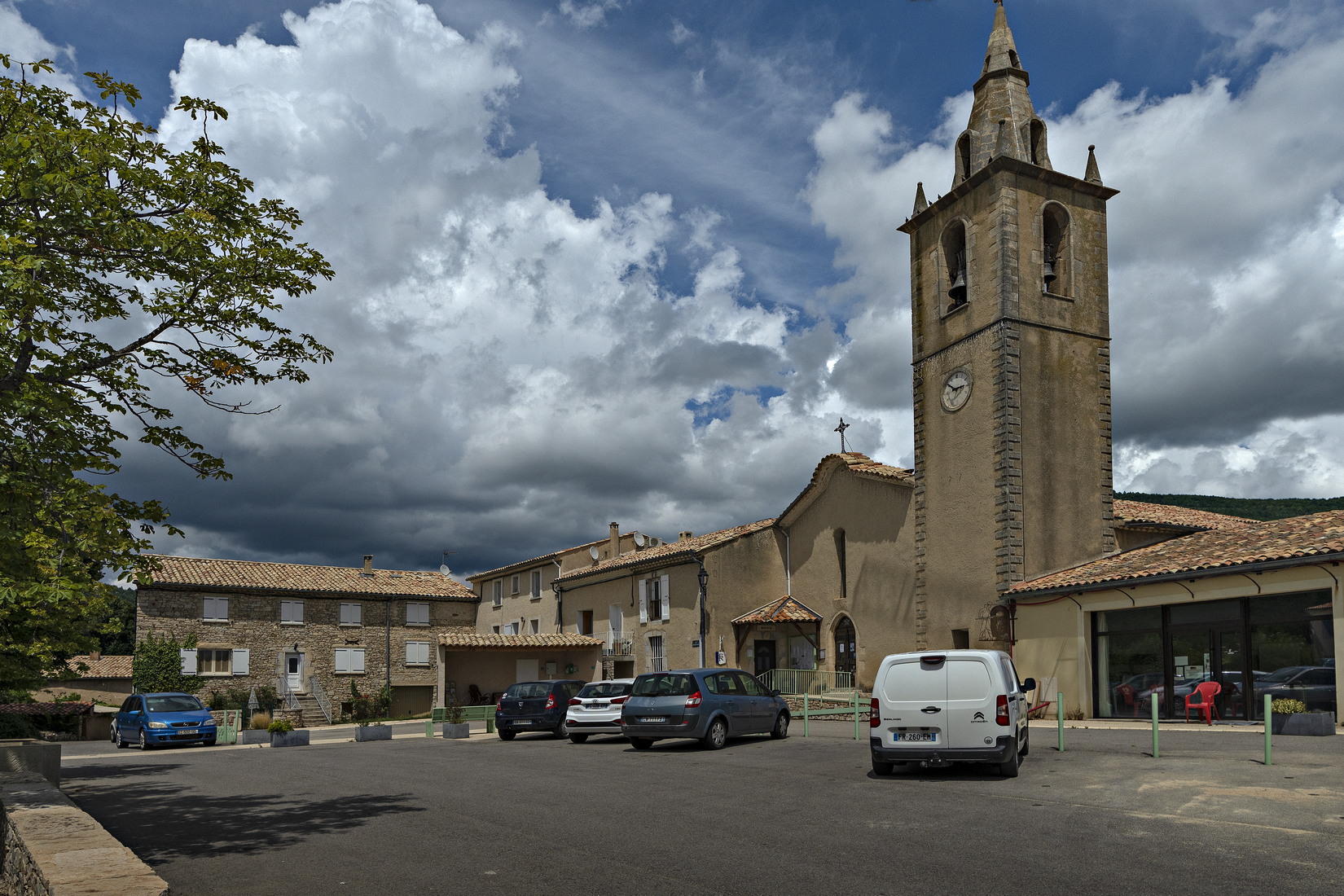
Saumane is a small village nestled in an unspoiled natural setting, known for its peaceful environment and picturesque landscapes.
The village is particularly appreciated for hiking, countryside walks, and its viewpoints over the surrounding mountains, notably the Montagne de Lure.
Saumane is one of those typical Provençal villages with its rural heritage, old stone buildings, and authentic atmosphere.
The name is written Saumana in classical Provençal (the traditional language of Provence) and Saumano according to the Mistralian spelling system.
The village name first appears in records in 1204 in the form Saumana.
Unlike most villages in the area, which were built on hilltops for defense, Saumane was established as early as the Middle Ages on the valley floor, along a passage route.
Following the great crisis of the 14th and 15th centuries—the Great Plague and the Hundred Years’ War—the village was nearly abandoned: only a single household was recorded in 1471. Today, 120 residents call it home.
what to see
Church of Saint-Pierre-ès-Liens: 15th century.
Beautiful hiking trails around the dry-stone shepherds’ huts.
Chapel of Saint-Michel in the hamlet of Bertranet: Built on a hill outside the village, it offers panoramic views over the surrounding valley. It was built as an ex-voto offering following the plague of 1720 and was restored in 1995.
A shaded picnic area offers the perfect spot for a relaxing break. To find it, search for ‘La Source’ on your GPS.
A sports court below the town hall.
Notable Figures
In 1960, Jean Giono filmed Crésus with Fernandel at Les Fraches in the Contadour and in the Jabron valley, with several scenes shot in the villages of L’Hospitalet and Saumane.
Saumane is a small village nestled in an unspoiled natural setting, known for its peaceful environment and picturesque landscapes.
The village is particularly appreciated for hiking, countryside walks, and its viewpoints over the surrounding mountains, notably the Montagne de Lure.
Saumane is one of those typical Provençal villages with its rural heritage, old stone buildings, and authentic atmosphere.
The name is written Saumana in classical Provençal (the traditional language of Provence) and Saumano according to the Mistralian spelling system.
The village name first appears in records in 1204 in the form Saumana.
Unlike most villages in the area, which were built on hilltops for defense, Saumane was established as early as the Middle Ages on the valley floor, along a passage route.
Following the great crisis of the 14th and 15th centuries—the Great Plague and the Hundred Years’ War—the village was nearly abandoned: only a single household was recorded in 1471. Today, 120 residents call it home.
Beautiful hiking trails around the dry-stone shepherds’ huts.
Chapel of Saint-Michel in the hamlet of Bertranet: Built on a hill outside the village, it offers panoramic views over the surrounding valley. It was built as an ex-voto offering following the plague of 1720 and was restored in 1995.
A shaded picnic area offers the perfect spot for a relaxing break. To find it, search for ‘La Source’ on your GPS.
A sports court below the town hall.
Notable Figures
In 1960, Jean Giono filmed Crésus with Fernandel at Les Fraches in the Contadour and in the Jabron valley, with several scenes shot in the villages of L’Hospitalet and Saumane.